When you look at modern athletic footwear, most shoes feature thick foam midsoles, tapered toe boxes, and elevated heels. While these design features offer immediate cushioning, they raise an important question: what happens to your foot strength when an external structure does all the work?
Moving toward barefoot training or minimalist shoes is a major topic in running and strength conditioning. But away from the hype, what does the research actually say about foot health, performance, and common overuse injuries?
Can Lifting Without Shoes Make You Stronger?
A common claim is that removing shoes instantly increases your maximum lifting capacity. The short answer from kinetic research is no—taking your shoes off will not instantly add 10 kg to your 1-Rep Max. Side-by-side studies comparing shod versus barefoot lifting show no acute jump in peak vertical force production (Hammer et al., 2017).
However, lifting barefoot or in flat, zero-drop shoes provides distinct mechanical advantages:
Eliminating Energy Leaks: Soft running shoes deform under heavy loads. Removing compressible soles ensures force is transferred directly into the floor rather than absorbed by foam.
Shorter Range of Motion: On pulls like the conventional deadlift, removing a 20 mm shoe sole lowers your height relative to the floor, slightly reducing the total vertical distance the barbell travels.
Enhanced Stability & Balance: Direct ground contact increases tactile feedback from sensory receptors in the sole of the foot, helping you make subtle balance adjustments across the tripod of the foot (heel, first metatarsal, fifth metatarsal) while reducing lateral sway.
Foot Core, Biomechanics, and Injury Risk
The foot relies on an internal support mechanism often referred to as the "foot core"—a collection of intrinsic muscles, tendons, and ligaments that dynamically control the arch during gait.
Over-reliance on heavily cushioned or highly structured shoes can lead to disuse weakness in these intrinsic muscles. When the foot lacks active dynamic control, movement faults such as over-pronation—where the arch collapses inward excessively and rapidly during weight-bearing—can place increased stress on surrounding soft tissues.
Strengthening the foot core through targeted training or gradual minimalist footwear exposure changes this dynamic:
Lower Injury Rates:
A 12-month randomized controlled trial involving recreational runners demonstrated that an 8-week foot-and-ankle strengthening program resulted in a 2.4x reduction in running-related injuries compared to control groups (Taddei et al., 2020).
Increased Muscle Volume:
Regular use of minimalist footwear or targeted intrinsic exercises increases the cross-sectional area (size) of key foot muscles like the abductor hallucis and flexor digitorum brevis, improving arch stiffness during propulsive movements.
Barefoot Training in Rehab for Common Foot & Ankle Conditions
Rather than viewing footwear as purely a passive support, modern sports therapy utilizes intrinsic foot strengthening and gradual barefoot loading as active rehabilitation tools for several common conditions:
1. Plantar Fasciitis
Plantar fasciitis involves micro-tears and degeneration at the attachment of the thick fascial band supporting the arch. While rigid arch supports can temporarily offload acute pain, long-term resolution often requires building active arch capacity. Research demonstrates that high-load strength training for the foot and toes (such as modified heel raises with a towel under the toes) significantly improves outcomes and speeds recovery in plantar fasciopathy (Rathleff et al., 2015). Strengthening the intrinsic foot muscles reduces the physical strain placed on the passive plantar fascia structure during landing.
2. Achilles Tendinopathy
Achilles tendinopathy affects the main tendon connecting the calf muscles to the heel bone. Traditional elevated-heel shoes shorten the calf-Achilles complex. While heel lifts are helpful to calm acute tendon pain initially, transitioning over time to zero-drop footwear restores full ankle range of motion and eccentric loading capacity through the tendon. Building intrinsic foot strength ensures the foot provides a solid, stable base during toe-off, preventing abnormal rotational forces on the Achilles tendon.
3. Tibialis Posterior Tendinopathy
The tibialis posterior tendon runs behind the inner ankle bone and serves as the primary dynamic stabilizer of the medial longitudinal arch, resisting over-pronation. When this tendon is overloaded due to poor intrinsic foot strength, arch collapse becomes pronounced. Integrating "short foot" exercises and intrinsic foot muscle training directly offloads the tibialis posterior by training the small foot muscles to share the workload of arch stabilization.
4. Managing Over-Pronation
Over-pronation is often treated by adding rigid medial post arch supports. However, addressing over-pronation by actively building intrinsic muscle volume trains the foot to dynamically resist excessive collapse on its own. Rebuilding this intrinsic control in rehab allows individuals to tolerate minimalist or barefoot footwear over the long term without relying on external motion-control features.
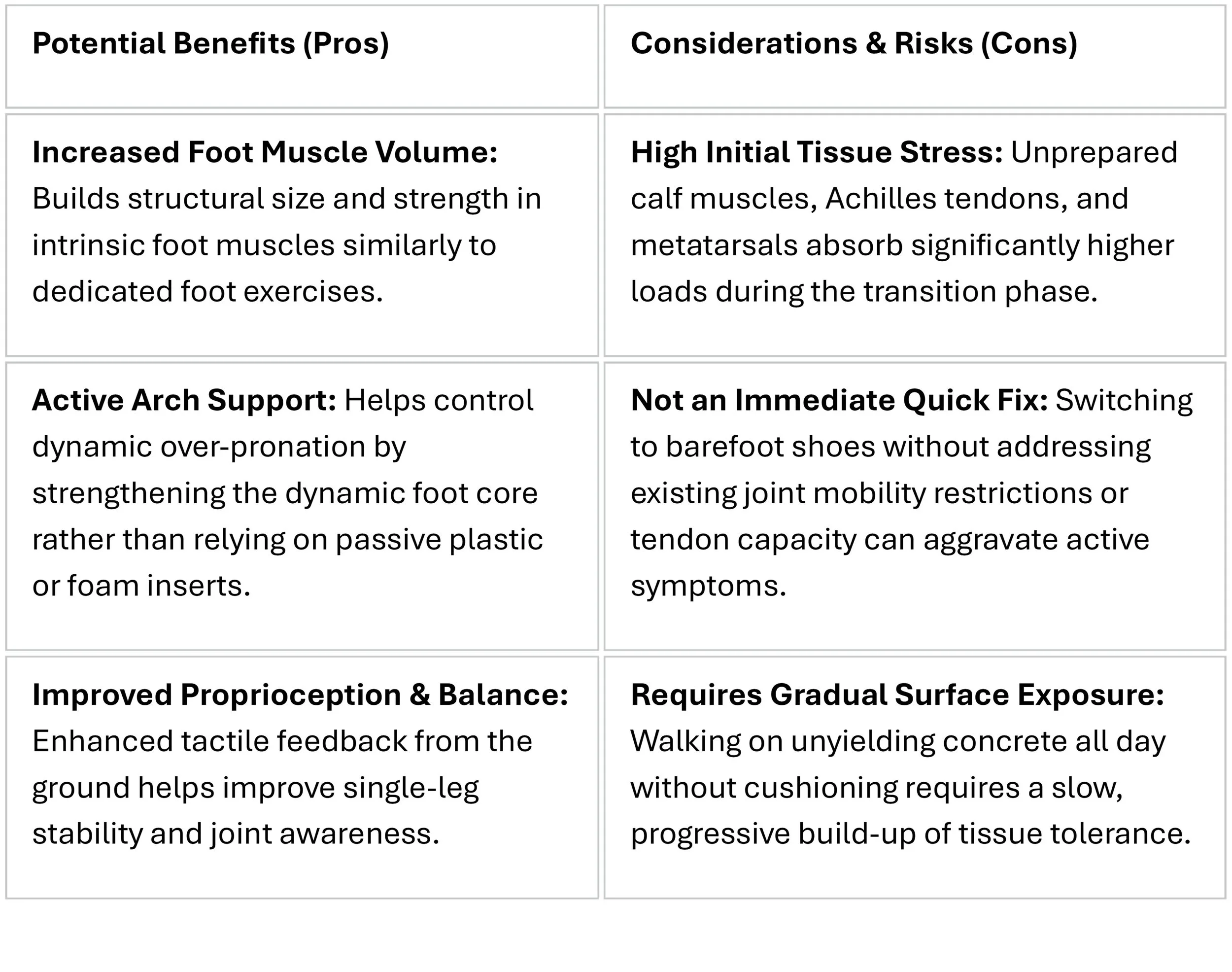
Pros vs. Cons of Barefoot Shoes
Transitioning to barefoot or minimalist shoes is a progressive conditioning process. Here is a balanced view of what to consider:
How to Safely Transition Long-Term
Believing that feet permanently require rigid external support to remain healthy is often an outdated approach. Our feet are highly adaptable when loaded progressively.
If you want to transition to minimalist shoes long-term—whether for daily wear, gym work, or running—the key is progressive load management:
Start Small: Use minimalist shoes for short periods initially (e.g., 30–60 minutes of daily walking or during strength training sessions).
Build the Foundation: Integrate targeted intrinsic foot exercises (like short-foot contractions, toe spreading, and resisted toe flexion) into your routine 2–3 times per week.
Listen to Tissue Feedback: Allow your calf complex, plantar fascia, and Achilles tendons time to adapt before increasing volume or introducing high-impact activities like running barefoot.
If you are currently managing an issue like plantar fasciitis, Achilles tendinopathy, or flat feet and want to know if minimalist shoes are appropriate for your specific movement mechanics, let’s evaluate your foot function at your next appointment.